

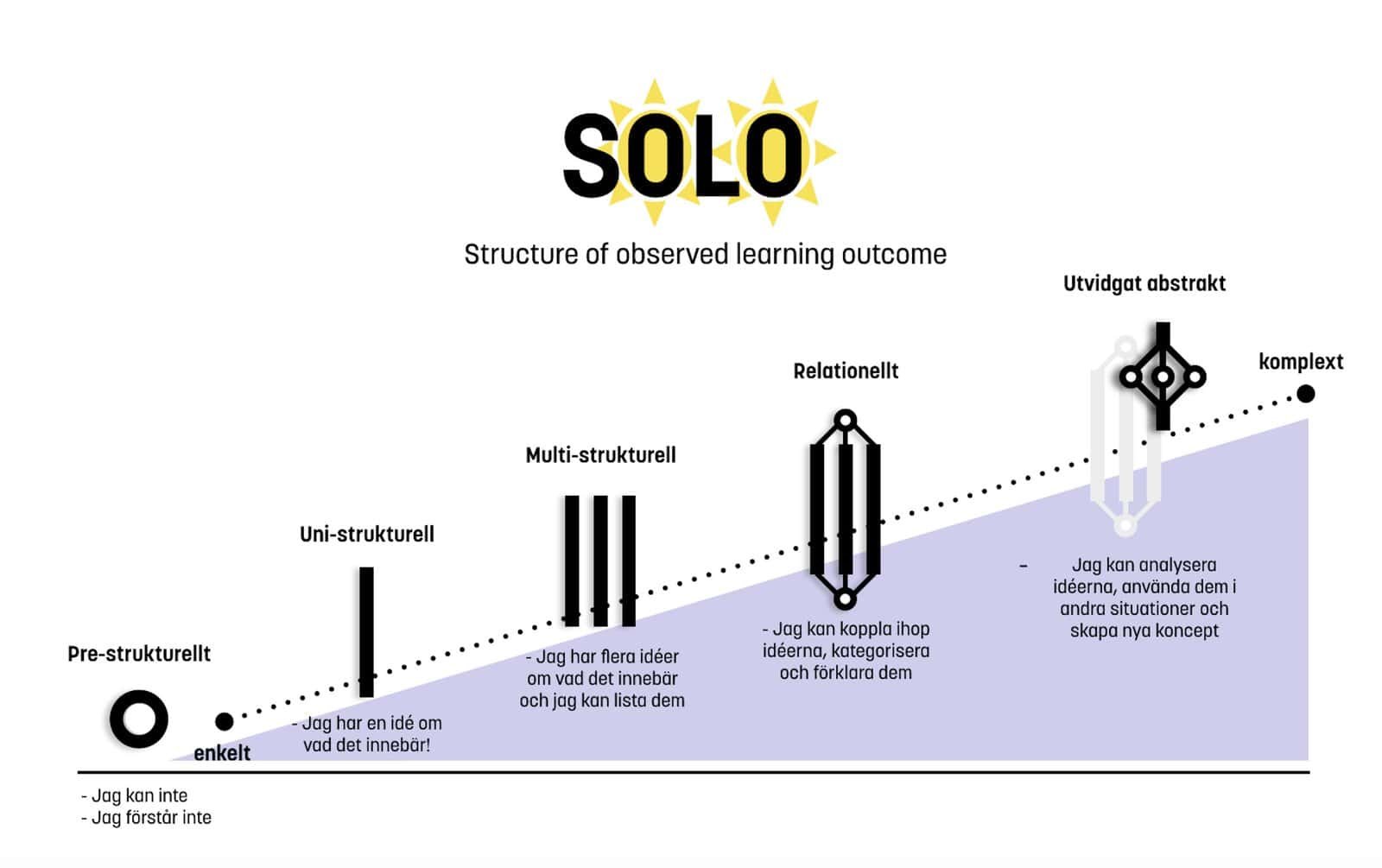
Our familiarity with Bloom’s Taxonomy may be greater than SOLO Taxonomy. Bloom’s Taxonomy organises learning objectives hierarchically from basic recall to creation, while SOLO Taxonomy evaluates the depth and structural complexity of student understanding.
SOLO Taxonomy stands for Structure of Observed Learning Outcomes. John Biggs and Kevin Collis (1982) developed it as an educational assessment framework. Teachers use it to classify the quality and complexity of observable learner responses across five SOLO levels, such as pre-structural, unistructural, multi-structural, relational, and extended abstract.
Unlike Bloom’s (1956) taxonomy, SOLO focuses on how learners respond. It helps with formative assessment, so teachers can see what to teach next. At the lower levels of SOLO Taxonomy, students demonstrate lower-order cognitive skills, while at higher levels, students demonstrate the ability to use complex inductive reasoning strategies.
The pre-structural level is the initial stage of SOLO Taxonomy, in which students demonstrate little or no understanding of a topic and often provide irrelevant or incorrect information. At this level, students lack a meaningful understanding of the subject matter.
Their knowledge is often fragmented, superficial, or incorrect, and they are unable to connect ideas or apply concepts effectively. Responses at this stage typically miss the point of the task and may include irrelevant comments, factual inaccuracies, or no response at all. Students may rely on rote memorisation rather than comprehension, thereby preventing meaningful engagement with the material.
At the uni-structural level, students have one relevant idea. They can define a term, recall a fact, or perform a single step, but they are still unable to connect it to anything else. They struggle to see the broader implications or relationships between ideas.
For example, a student may understand the definition of a scientific term but may not be able to apply it in a practical context or relate it to other concepts within the subject. To support students at this level, teachers can encourage them to explore connections between ideas and provide opportunities to practice applying their knowledge in different scenarios.
Here, teachers can use guided discussions, hands-on activities, and collaborative learning experiences to promote deeper engagement.
In the Multi-structural Level, students can identify several relevant ideas but have not yet connected them into a coherent picture. There is a growing awareness of the complexity of the subject matter. For instance, a student might be able to list the components of a cell and describe their functions, but may struggle to explain how these components work together to support the cell’s overall function. To help students progress and develop a more integrated understanding, teachers can encourage them to share insights and challenge each other’s critical thinking through activities such as concept mapping or group projects that require collaboration and discussion.
At the relational level, students begin to connect and integrate different aspects of their knowledge. This is where deeper thinking begins. Students start linking ideas, seeing cause-and-effect, and comparing across contexts. At this level, students in science do not just know what photosynthesis is; they can explain why it matters for a particular ecosystem and predict what happens when one variable changes.
The highest level of SOLO Taxonomy is the Extended Abstract Level. Here, students demonstrate the ability to generalise their knowledge and apply it creatively in novel contexts. Students take their understanding beyond the given context. They are generating new ideas, making cross-disciplinary connections, or applying a concept in a way they were not taught. This is harder to plan for, but it is worth building tasks that make it possible.
SOLO gives us a common language for talking about the quality of thinking, not just whether an answer is right or wrong. That is useful in feedback conversations, in planning, and in department moderation. It also works across subjects. Unlike some frameworks that sit more comfortably in English or Humanities, SOLO applies equally well in Mathematics, Science and Languages. The levels describe how thinking develops, not what thinking looks like in a specific discipline.
Bloom’s taxonomy classifies cognitive skills from remembering to creating. SOLO taxonomy describes the structural complexity of a student’s response to a specific task. Both are useful; they answer different questions. Bloom’s asks, “What kind of thinking?” SOLO asks, “How well-developed is this thinking? “SOLO taxonomy works across Years 7–12 but can be adapted for lower levels.
SOLO describes a quality of thinking, not a grade. A pre-structural response on a genuinely difficult task might come from a strong student encountering new material. Bloom’s and SOLO both describe levels of thinking, but they are built differently. Bloom’s is a hierarchy of cognitive skills, such as remember, understand, apply, analyse, evaluate, and create, while SOLO describes the structural complexity of a response. They are complementary, not interchangeable.
For students, the benefit of the SOLO Taxonomy is clarity. When they know what a relational response looks like, rather than a multi-structural one, they have a target. By clearly defining learning objectives and outcomes, SOLO Taxonomy helps students understand what is expected of them. This clarity can lead to improved academic performance and a more experienced individual.
This nuanced approach helps them move beyond mere recall of facts and figures, instead fostering deeper learning that sticks with them long after the lesson is over. For instance, when exploring a topic like climate change through the SOLO taxonomy, students will not only learn about its causes and effects but also critically evaluate different mitigation strategies and their feasibility.
Implementing the SOLO taxonomy in the classroom can be a transformative experience for teachers. By adopting this framework, educators can rethink their teaching practices and make informed decisions that cater to diverse learning needs. One of the significant benefits of SOLO is its ability to provide clear benchmarks for student understanding.
Teachers empowered with SOLO can create more inclusive learning environments where students feel supported and challenged. For instance, they can use the SOLO taxonomy to assess student progress and identify areas where students may need extra help or enrichment opportunities. This helps teachers tailor their instruction to meet the needs of all learners, rather than relying on one-size-fits-all approaches. The benefits of using the SOLO taxonomy are numerous.
By recognising the different stages of learning, teachers can create assessments that accurately measure student progress, providing a more comprehensive picture of each individual’s strengths and weaknesses. Students, in turn, benefit from a tailored approach to learning, one that addresses their specific needs and promotes deeper understanding.
In conclusion, the SOLO taxonomy is an approach to teaching that breaks complex concepts into manageable levels of understanding. One of the most significant cognitive benefits is the development of critical thinking skills. By breaking down complex concepts into increasingly sophisticated levels of understanding, SOLO encourages teachers to analyse and evaluate information from multiple perspectives.
SOLO Taxonomy has the potential to cultivate a culture of lifelong learning. By emphasising the importance of deep understanding and critical thinking, teachers can inspire students to become curious, self-motivated learners who seek knowledge beyond the classroom; a mindset is essential in today’s rapidly changing world, where the ability to adapt and learn continuously is crucial for success.
About the Author


Masum Billah works as the President of the English Teachers' Association of Bangladesh (ETAB), Dhaka, Bangladesh. He previously worked as an Education Specialist at BRAC, an international NGO in Bangladesh.


