

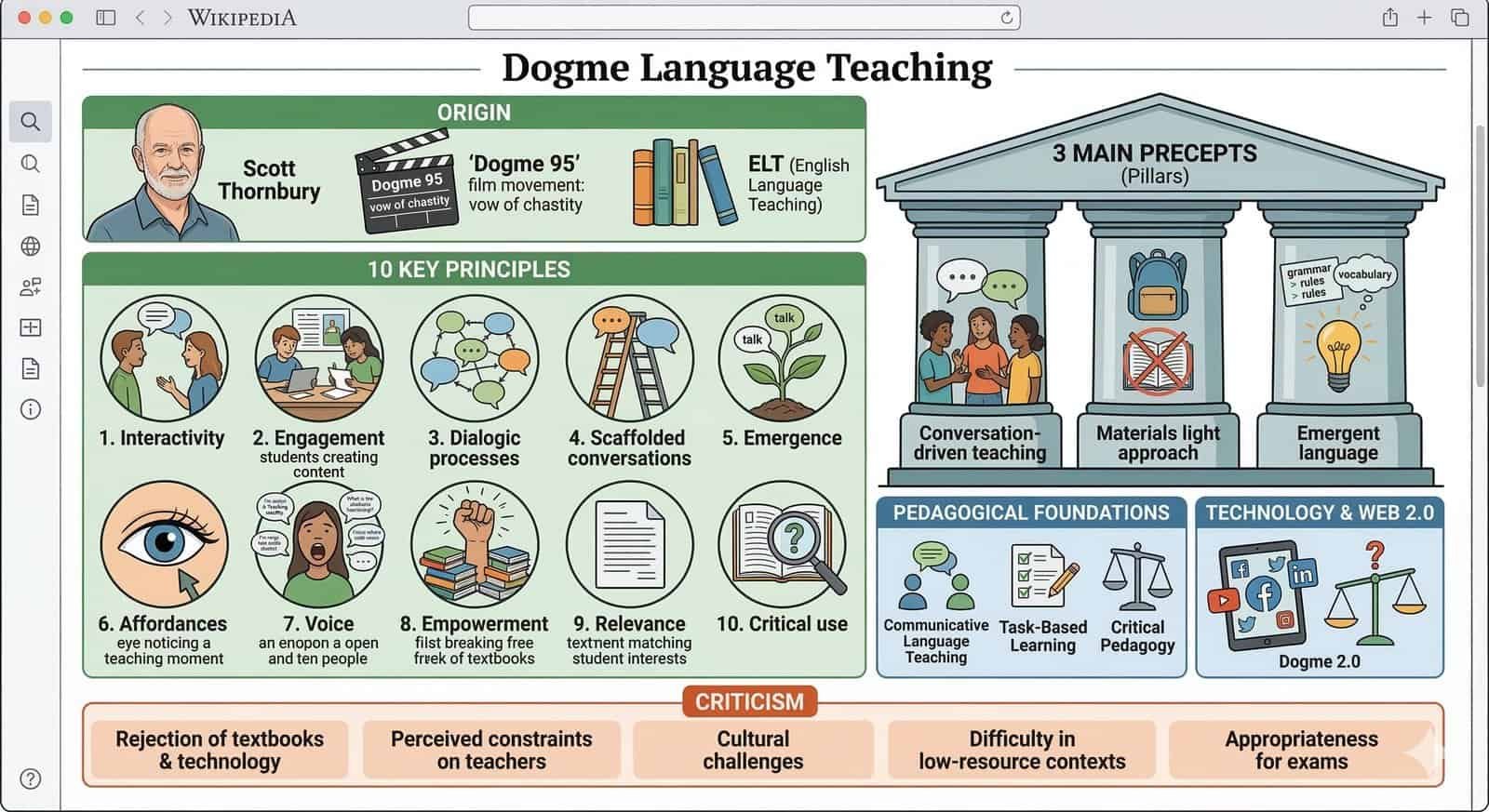
Dogme ELT is a communicative approach to language teaching that encourages teaching without published textbooks and emphasises conversational communication among learners and teachers.
It is considered both a methodology and a teaching movement, whose proponents challenge a perceived over-reliance on materials, coursebooks, and the grammatical syllabus. Dogme ELT believes that language learning naturally emerges during the learning process. This differs from acquiring skills through pre-planned lessons.
In Dogme teaching, the focus is on real communication and interaction among students and teachers. We want the language that learners use during these spontaneous interactions to be valuable and relevant. We can also say that Dogme ELT is a teaching methodology that emphasises conversational communication and student-driven learning over the use of textbooks and prepared materials.
It challenges reliance on resources, advocating lessons generated by learners’ interests and experiences. It aims to create a more engaging and relevant learning environment for students. This method is grounded in humanistic theories of education, emphasising personal agency and intrinsic motivation.
This movement in ELT started with a group of teachers opposed to ‘resource-heavy’ teaching, arguing that if learners are not interested, they will not learn, and that all materials should be generated by learners and the lessons directed by them, rather than the teacher.
For example, Learners come to class to discuss something in the news. The teacher encourages and facilitates discussion and provides answers to grammar and vocabulary questions as they arise.
In a world where authenticity and engagement matter more than ever, Dogme ELT offers a refreshing, human-centred alternative. The movement was popularised by Scott Thornbury, who argued that overplanning, pre-packaged materials, and rigid syllabi often get in the way of real language use.
In a Dogme ELT classroom, the content is driven by student conversation, curiosity, and immediate communication needs. There is no textbook to flip through and no grammar point to rush toward. Instead, the teacher and students co-create the lesson based on what naturally comes up.
Dogme ELT is built on a few foundational beliefs that set it apart from more traditional ESL methods, such as (i) Meaningful talk—especially when it reflects the learners’ real lives—is the most powerful tool in the classroom. (ii) The lesson unfolds based on dialogue, not pre-written content. (iii) Instead of presenting vocabulary or grammar up front, the teacher listens for language gaps and addresses them as they appear in conversation. (iv) The teacher guides, prompts, and supports—but does not dominate or lecture. (v) Corrections and language focus happen in the moment, shaped by what learners are trying to express.
These principles encourage adaptability and keep lessons rooted in what students actually want and need to communicate, rather than in abstract curriculum goals.
Faces of Dogme ELT Lesson
A Dogme lesson might begin with a simple, open-ended question: “What did you do this weekend?” From there, the class flows naturally based on what students want to express. As the discussion unfolds, the teacher listens closely. If a learner struggles to explain something or uses awkward phrasing, the teacher steps in—clarifying meaning, writing corrections on the board, or highlighting useful structures. These mini-lessons happen in real time and are driven by need, not pre-planned objectives.
This reactive style keeps lessons fresh and relevant. One class might focus heavily on past-tense storytelling, while another might lean into travel vocabulary or opinion language—all based on the conversation that emerges. Moreover, students stay engaged because they are learning a language they actually want to use.
The direct route to learning lies in the interactivity between teachers and learners, and between the learners themselves. Materials-mediated teaching is the scenic route to learning. Learning is a social and dialogic process, where knowledge is co-constructed rather than ‘transmitted’ from teacher/coursebook to learner. Language, including grammar, emerges rather than being acquired.
Emergent language tends to come up unpredictably. This is in contrast to the structural syllabus, whereby the ‘grammar structure of the day’ reigns supreme. Apart from promoting the classroom dynamic conducive to a dialogic and emergent pedagogy, the teacher should strive to optimise language-learning affordances. In a nutshell, affordances are learning opportunities that arise during the lesson.
They tend to arise from communication and are thus unpredictable. Directing attention to features of emergent language would be one example of an affordance. The learner’s beliefs, knowledge, experiences, concerns and dreams are valid content in the language classroom. This relates to the need to provide space for the learner to express their genuine voice.
Freeing the classroom from third-party, imported materials empowers both teachers and learners. Teachers and learners need to unpack the ideological baggage associated with English Language Teaching materials – to become critical users of such texts.
Benefits of this Dogme ELT approach
Dogme ELT has some powerful advantages, especially for teachers who thrive on human connection and spontaneity:(i) Lessons adapt to each group, each moment—no more one-size-fits-all curriculum, which means highly personalised. (ii)Learners must listen, reflect, and form thoughts independently, which promotes their critical thinking. (iii) Teachers become collaborators, not just authority figures, which promises to strengthen classroom relationships. (iv) As readymade materials are not used, teachers can focus more on interaction and feedback, which is necessary for any effective teaching-learning situation.
As Dogme ELT focuses heavily on conversation, which significantly improves students’ speaking abilities, spontaneity, and confidence. By focusing on the “emergent language” that comes directly from learners, the lessons become more personalised, relevant, and engaging than textbook-led classes.
It encourages a “materials-light” approach, allowing teachers to rely on their skills and student input rather than being constrained by textbooks. The approach fosters a strong, communicative atmosphere, improving relationships between teachers and students, and among peers. It encourages spontaneity, allowing teachers to adapt to students’ immediate needs and interests, thereby fostering creativity in the classroom.
Challenges this approach may face
Like any method, Dogme ELT has its downsides—and it is not a perfect fit for every classroom. (i) Without strong facilitation, a Dogme class can change track or feel unfocused. A risk of chaos may arise. (ii) Schools that follow strict curricula or emphasise exam preparation may not allow the flexibility Dogme needs. (iii) It takes skill, patience, and confidence to build lessons on the fly and manage spontaneous input effectively, so it sometimes remains a teacher-dependent class. (iv)Some assume “no prep” means “no effort.” In truth, Dogme demands intense presence, listening, and language awareness.
It is not about winging it. It is about trusting the process—and our ability to guide learners through real communication.
Conclusion
The approach promotes the use of “real-time” language, ensuring that the classroom focuses on what learners are actually trying to say rather than a pre-packaged syllabus. Dogme challenges conventional teaching norms. It focuses more on spontaneity and simplicity. It differs greatly from the ‘resource-heavy’ teaching methods you may use or were trained to use.
Instead, Dogme ELT prioritises conversation-driven and learner-centred experiences. As a result, it reduces the reliance on coursebooks. It breaks free from controlled learning and instead lets learning happen naturally. This makes the classroom a lively place where students take the lead.
About the Author


Masum Billah works as the President of the English Teachers' Association of Bangladesh (ETAB), Dhaka, Bangladesh. He previously worked as an Education Specialist at BRAC, an international NGO in Bangladesh.


