

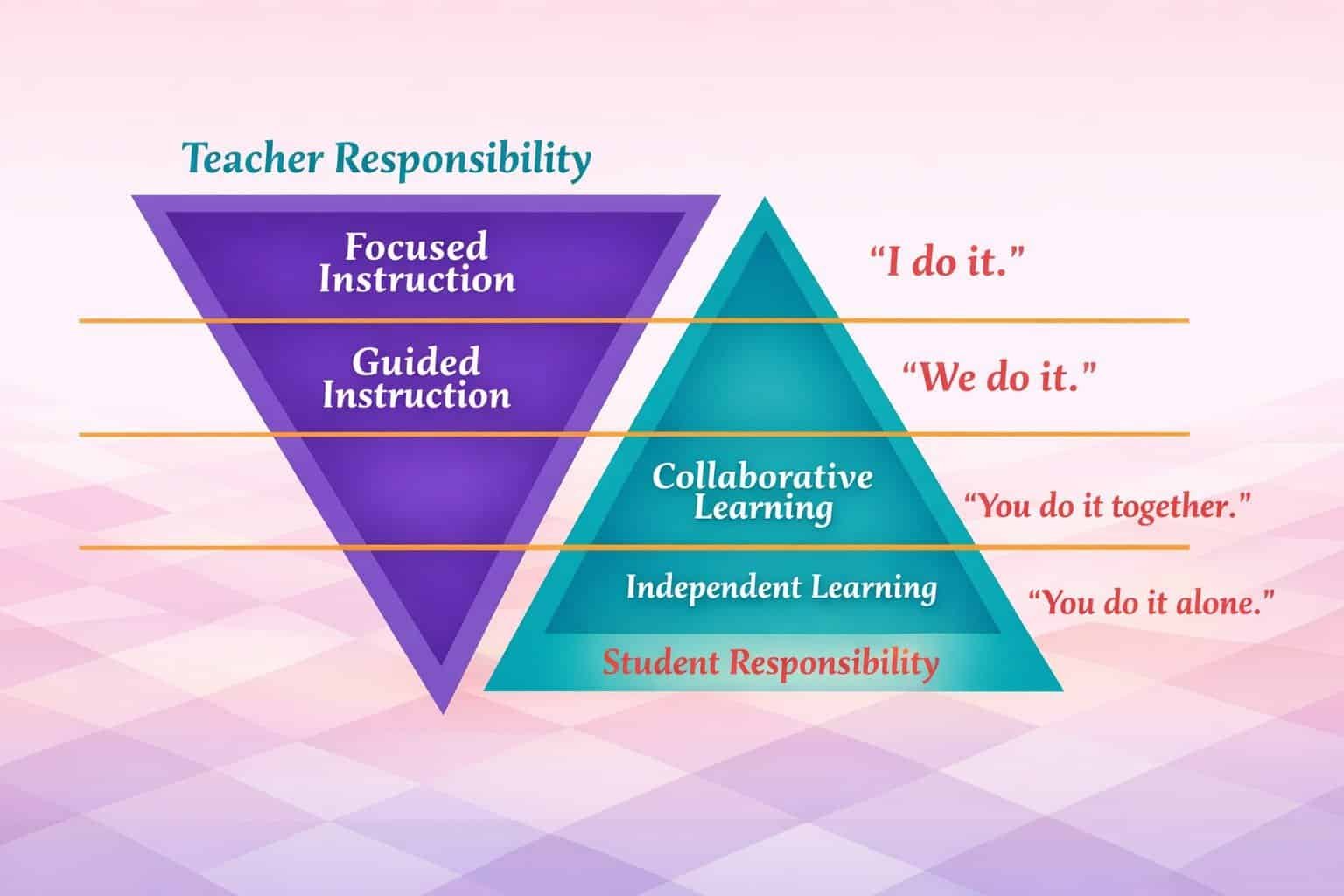
The way teachers teach and pupils learn has been revolutionised by the Gradual Release of Responsibility (GRR) model. The GRR model is built on the idea that teachers should gradually transfer responsibility from themselves to their students as they progress through the learning process.
It has its roots in the late 20th century, when education researchers began to question traditional teaching methods. The GRR model gained momentum in the 1990s and early 2000s as educators began implementing student-centred approaches.
Dr Douglas B. Fisher and Nancy Ebbeler’s research emphasised the importance of balancing teacher-led instruction with increasing student autonomy. This GRR model follows a sequence of steps- ‘ I do, we do, you do’ where the teacher first demonstrates ( I do ), then collaborates with the students ( we do) and finally allows students to work independently (you do).
This GRR model, introduced by Pearson and Gallagher in 1983, aims to foster student independence and engagement in the learning process. It is widely used in various educational settings to enhance student learning outcomes. The Bangladesh government plans to introduce it at the primary education level.
We already have some idea that the GRR model is a structured approach that emphasises students’ ability to learn independently and to take on more responsibility as they progress through the learning process. This model consists of four stages — the teacher models the material, explaining the process and breaking it down into steps.
The teacher and students work together on the task, with the teacher providing scaffolds and immediate feedback. Then comes collaborative learning –students work in small groups to complete tasks, relying on each other for support. Students apply their knowledge independently and assess their mastery.
Through this GRR model, teachers should strive for a delicate balance, gradually releasing responsibility to students as they become more confident and competent. For example, if teaching a math concept, a teacher may start by modelling a problem, then have students work individually, with guidance from a partner or mentor, before moving on to independent practice.
Engaging students in the gradual release of responsibility model can be a challenge. As teachers transition from direct instruction to guided and independent practice, some students may lose interest or motivation. However, with thoughtful planning and implementation, a motivated teacher can minimise this risk.
In the first step, the teacher models a task or concept to the whole group. During their modelling, the teacher should walk them through the process and break it down into steps. The task should remain visible to the students at all times. The most successful teachers during the modelling phase are those who can explain and demonstrate concepts in simple, easy-to-understand terms.
During this modelling phase, students are mostly passive learners. They observe the teacher doing the work. However, it is good practice to continue to gauge students’ responses throughout this step. Students might get confused, lose eye contact, and start to fidget. If this is the case, the task needs to be paused and broken down into even more straightforward steps. The final step is the independent phase.
The goal in this phase is to allow students the chance to conduct and complete tasks without the teacher’s oversight. At this step, the students will go off on their own, but the teacher will be available if needed. Students who need help will need to approach the teacher to request assistance, effectively giving them the chance to return to step 3 for instructional reinforcement.
Many of our successful and experienced teachers indeed follow this GRR model in their own classes, even though it is foreign to them. To implement it successfully, teachers of all levels can benefit.
The Ministry of Primary and Mass Education has initiated introducing this model for primary school children, which we think will gradually expand to secondary, higher secondary, and tertiary levels. Learning requires interaction. It is an action-oriented experience, not a passive one.
Best practices for instruction reflect these theoretical orientations. The need for interaction—with the teacher, the content, and peers—is essential for learning. However, the interactions cannot be mindless. A systematic approach for shifting the cognitive work from teacher to learner is in order.
This shift requires a gradual release of cognitive responsibility across every lesson. Using this framework, literacy, language, and disciplinary knowledge can be developed so that all students achieve.
About the Author


Masum Billah works as the President of the English Teachers' Association of Bangladesh (ETAB), Dhaka, Bangladesh. He previously worked as an Education Specialist at BRAC, an international NGO in Bangladesh.


