

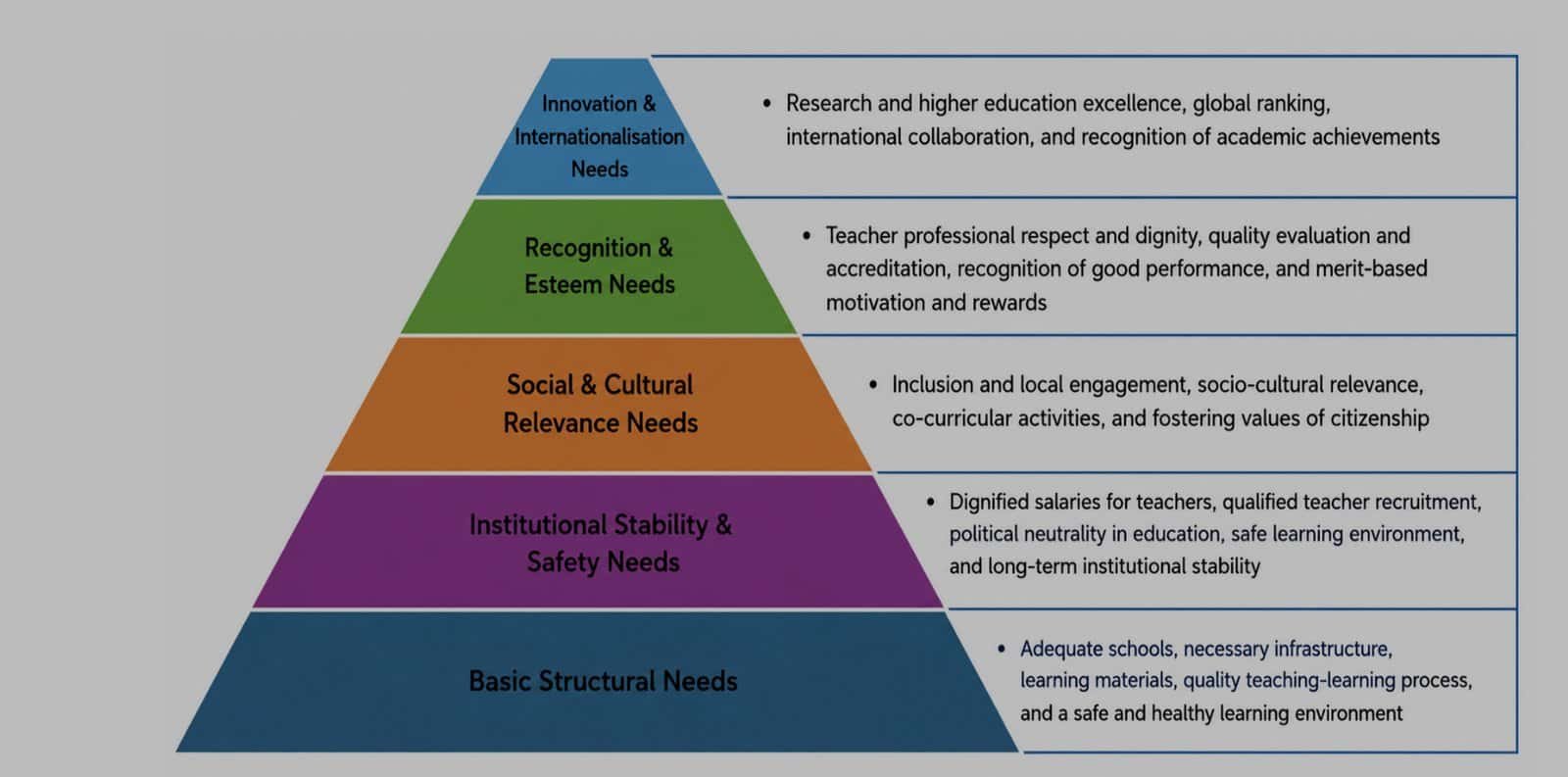
A few days ago, one of my Facebook friends and a junior from my university department, Dr Goutam Roy, a Lecturer at Charles Sturt University, shared a thoughtful reflection on educational reform on his wall. Drawing inspiration from Abraham Maslow’s famous “Hierarchy of Needs” theory, he attempted to reinterpret Bangladesh’s education system through a similar layered framework of needs. His post was not presented as a formal academic model or a research-based theory. Yet, as I read through it, I found myself deeply struck by its simplicity, clarity, and uncomfortable truth.
Sometimes the most powerful ideas are not those emerging from policy documents or international conferences, but those that compel us to rethink what we have long taken for granted.
Maslow’s theory, developed in the mid-twentieth century, argues that human beings move through a hierarchy of needs. At the bottom are physiological necessities such as food, sleep, and shelter. Once these are met, individuals begin to seek safety and security. Only after achieving relative stability do they move toward social belonging, esteem, and eventually self-actualisation. The theory has been criticised on several grounds, particularly for its rigid linearity and its limited sensitivity to cultural contexts. Nevertheless, one core insight remains profoundly influential: higher aspirations cannot sustainably flourish when foundational needs remain unmet.
Dr. Roy’s attempt to apply this logic to Bangladesh’s education system felt surprisingly illuminating.
According to the framework he sketched, the bottom layer of Bangladesh’s educational hierarchy consists of foundational structural needs — adequate school buildings, classrooms, sanitation facilities, electricity, learning materials, libraries, laboratories, digital devices, internet connectivity, and manageable student-teacher ratios. The next layer involves institutional stability and security — qualified teachers, dignified salaries, professional autonomy, transparent recruitment, depoliticised administration, and continuity of learning during emergencies or disasters.
Only after securing these lower layers, the framework suggests, can the system genuinely move towards higher-order educational goals such as social inclusion, professional recognition, innovation, research culture, global competitiveness, and internationalisation. The more I reflected on this framework, the more I realised how accurately it captures the contradictions of educational policymaking in Bangladesh.
For decades, we have become accustomed to discussing education primarily through the lens of high-level reforms. Every few years, there is a new debate about curriculum transformation, competency-based education, digital learning, smart classrooms, artificial intelligence, international rankings, or future-ready skills. These themes dominate policy discussions, seminars, newspaper columns, and television talk shows. Governments announce ambitious reforms with grand promises of educational transformation.
But beneath these lofty conversations lies an uncomfortable reality: much of the foundational educational ecosystem remains deeply fragile.
In countless primary and secondary schools across Bangladesh, students still study in overcrowded classrooms where fifty or sixty children are squeezed into spaces designed for far fewer learners. Many schools lack functioning libraries, laboratories, playgrounds, or adequate sanitation facilities. In remote areas, schools continue to struggle with electricity shortages and unreliable internet access. Teaching-learning materials remain insufficient. Climate-vulnerable regions such as haor areas, char lands, hill tracts, and coastal belts face additional barriers due to flooding, erosion, remoteness, and infrastructural vulnerability.
Under such conditions, what does it truly mean to speak about twenty-first century learning?
No curriculum — however modern or internationally aligned — can independently compensate for structural deprivation. One cannot realistically expect transformative educational outcomes from a classroom where a single teacher must manage sixty students with limited teaching aids and almost no individualised support. Even the most well-designed curriculum ultimately depends on the conditions under which it is implemented.
This is where the educational hierarchy framework becomes particularly important. It reminds us that educational reform is not merely about changing textbooks or introducing new pedagogical terminology. Reform requires a sequential strengthening of the ecosystem itself.
Take the issue of teachers, for example. Public discourse frequently blames teachers for poor learning outcomes. Yet teachers themselves operate within deeply constrained institutional environments. Many face low salaries, job insecurity, excessive workloads, limited professional development opportunities, and increasing administrative burdens. In universities, faculty members are often expected to teach six or seven courses per semester while simultaneously engaging in research, administrative responsibilities, and student supervision.
Under such pressure, how can meaningful intellectual engagement flourish? A university cannot realistically aspire to global academic excellence when its teachers are overworked and its students struggle with accommodation, nutrition, mental health support, or access to research facilities. Similarly, secondary schools cannot deliver competency-based learning if teachers lack sufficient training, resources, and classroom support.
In many ways, Bangladesh’s education system appears trapped in what may be called a “top-heavy reform culture”. We consistently focus on the uppermost layers of educational aspiration while neglecting the foundational base required to sustain them.
There are political reasons for this tendency. Structural reforms are expensive, time-consuming, and often invisible in the short term. Building thousands of classrooms, improving sanitation, reducing student-teacher ratios, modernising laboratories, strengthening libraries, or improving teacher welfare does not create dramatic headlines. By contrast, announcing a new curriculum, introducing digital platforms, or promising global rankings creates immediate public visibility and political capital.
As a result, policymakers are often incentivised to prioritise symbolic reforms over foundational investments.
Unfortunately, public intellectual discourse sometimes reproduces the same pattern. We are fascinated by ideas of innovation, internationalisation, and technological transformation because they sound modern and aspirational. Yet conversations about classroom density, teacher fatigue, rural school infrastructure, or school maintenance rarely generate similar excitement.
This imbalance has consequences. When foundational weaknesses are ignored, higher-level reforms often become performative rather than transformative. They create the appearance of progress without addressing the deeper systemic barriers that prevent meaningful educational change.
The COVID-19 pandemic exposed this reality with brutal clarity. During the pandemic, discussions around online learning and digital classrooms expanded rapidly. Yet millions of students lacked devices, internet access, electricity, or supportive learning environments at home. The pandemic revealed that technological solutions cannot substitute for structural preparedness and educational equity.
Similarly, climate change poses another major challenge that reinforces the importance of foundational thinking. Schools in flood-prone or climate-vulnerable regions require resilient infrastructure long before they can meaningfully engage with advanced educational innovation. Without safe and stable learning environments, continuity of education itself becomes uncertain.
This is why I believe the hierarchy framework shared by my junior deserves deeper attention. Not because it offers a perfect model, but because it compels us to ask a crucial policy question: are we attempting to solve educational problems from the top down when they actually require bottom-up reconstruction?
Perhaps Bangladesh does not primarily need another ambitious curriculum overhaul at this moment. Perhaps it needs a decade-long national commitment to educational foundations: smaller classrooms, adequate teacher recruitment, stronger school infrastructure, better nutrition, reliable electricity, accessible learning materials, functioning libraries, and sustained professional support for teachers.
Perhaps our national educational ambition should begin with guaranteeing that every child, regardless of geography or social background, has access to a safe, functional, adequately resourced, and humanely managed learning environment.
Only then can higher aspirations — creativity, innovation, critical thinking, research excellence, internationalisation, and global competitiveness — emerge meaningfully and sustainably. Maslow’s theory reminds us that development is cumulative. Skipping foundational stages may create the illusion of rapid progress, but such progress often remains fragile and unsustainable.
Bangladesh’s education system does not lack ambition. What it often lacks is patience with foundations. And perhaps that is the most important lesson I took from my junior’s Facebook post: before reaching for the top of the pyramid, we must first strengthen the ground beneath it.
About the Author


Musharraf Tansen is an education professional with over two decades of experience in education in emergencies, early childhood development, early-grade reading and literacy, and girls’ education. He has worked with leading international organisations, including Malala Fund, Plan International, World Vision, Save the Children, SDC, IOM, FCDO and the British Council.


